Claude Frollo
The Hunchback of Notre DameClaude Frollo is a cleric and scholar whose life moves from disciplined study and familial responsibility toward a desperate, controlling pursuit of Esmeralda. Archdeacon of Josas and a figure of authority at Notre-Dame Cathedral, he adopts Quasimodo as a child and later treats him as a dependent whose strength can serve his commands. His learning, his religious office, and his capacity for care never disappear; instead, they become bound up with suspicion, obsession, and actions that bring suffering to others as well as to himself.
Identity and Formation
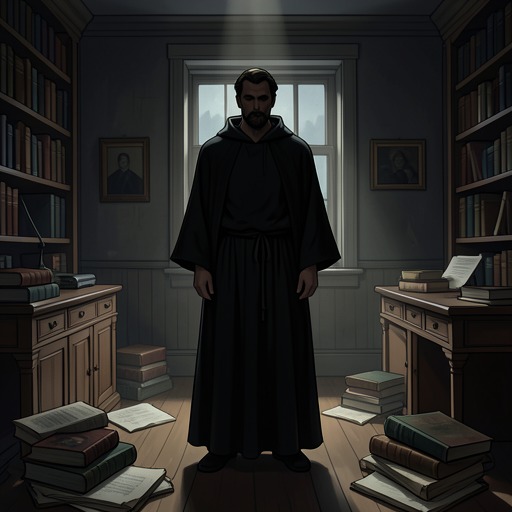
Frollo is introduced as a young cleric with a severe face, a broad brow, and a penetrating gaze. His family belonged to the Parisian landed bourgeoisie and held the fief of Tirechappe, a collection of twenty-one houses dependent on the Bishop of Paris. His parents had destined him for the ecclesiastical profession from infancy. As a boy, he learned Latin and was sent to the college of Torchi at the University of Paris, where his education centered on religious texts and scholarly discipline.
His intellectual appetite extended well beyond theology. He studied successive collections of canon and civil law, then medicine, the liberal arts, and the languages Latin, Greek, and Hebrew. By eighteen, he had passed through the four faculties. The account presents learning as the organizing purpose of his early life: he acquires knowledge with exceptional speed and intensity, while his habits of restraint and seriousness establish him as an austere young scholar.
The plague of 1466 abruptly turns that inward life toward family responsibility. When word reaches him that the disease is devastating the Rue Tirechappe, Frollo hurries to his parents’ home and finds that both have died. His infant brother Jehan remains alive, abandoned in his cradle. Frollo takes the child with him; the loss makes him, at nineteen, the head of the family and forces him away from the life of study he had known. He arranges for Jehan to be nursed at the family’s fief of Moulin and devotes himself to securing his brother’s future.
Care, Office, and Quasimodo
Frollo’s responsibility for Jehan shapes his decision to remain in the Church. He resolves not to marry or have children of his own, directing his hopes instead toward his brother’s welfare. His learning, status as a vassal of the Bishop of Paris, and clerical commitment open a path through the Church: at twenty, by special dispensation, he becomes a priest and serves at an altar in Notre-Dame Cathedral. His scholarly reputation spreads from the cloister to the wider population, where it changes into a rumor that he is a sorcerer.
On Quasimodo Sunday, returning from mass, Frollo encounters the deformed infant left among the foundlings. The account emphasizes the child’s multiple physical impairments, but also notes his apparent liveliness and strength. Frollo’s compassion increases at the sight of him. He decides to rear the child as a charitable act undertaken, in his own reasoning, for Jehan’s spiritual benefit. He names him Quasimodo, marking either the day on which he found him or the child’s incomplete appearance.
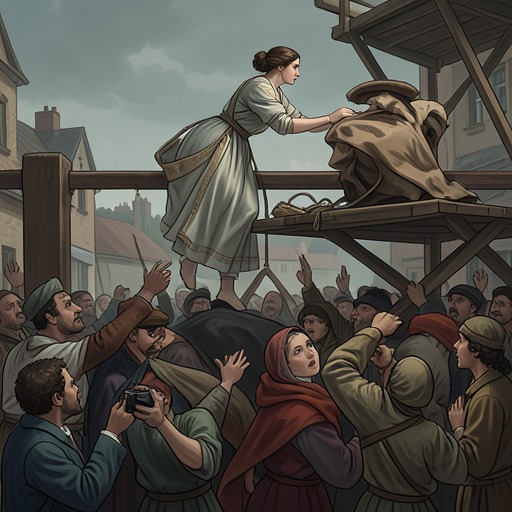
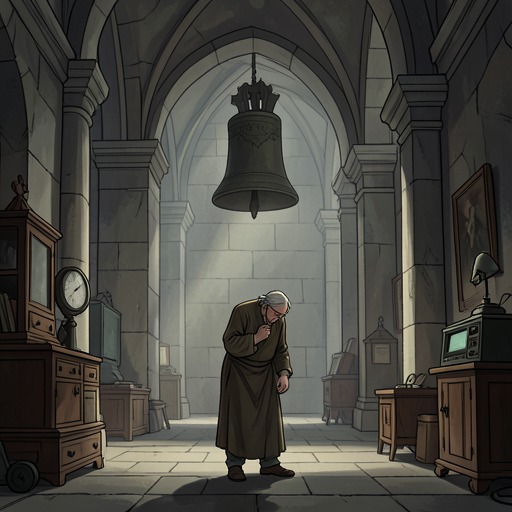
By 1482, Quasimodo has become the bellringer of Notre-Dame Cathedral, a position he holds through Frollo’s influence. The relationship is close but unequal. In the Feast of Fools crowd, Frollo abruptly tears away Quasimodo’s mock insignia and summons him through signs rather than speech. Quasimodo drops to his knees before him, and, despite being powerful enough to overpower the priest, obeys his gestures. When the crowd gathers against Frollo, Quasimodo steps between them, shields him, and escorts him away. Frollo’s authority over his adopted son is therefore shown not only as a consequence of their history but as a present force: Quasimodo protects the man who commands him.
That bond also has a painful limit. When Quasimodo is exposed at the pillory, he sees Frollo approach and greets him with visible relief and tenderness. Frollo lowers his eyes and rides past without acknowledging him. The scene reverses the earlier image of the dependent son defending his adoptive father: Quasimodo still looks to Frollo for recognition, while Frollo refuses to answer that appeal.
Learning, Authority, and Suspicion
Frollo’s learning eventually pushes him beyond the subjects accepted by the schools and the Church. After mastering what the account calls the permitted fields of human knowledge, he is said to have pursued alchemy, astrology, and hermetic studies. The narrative marks these pursuits as rumor rather than established fact, while noting that he often visits the cemetery of the Saints-Innocents and attends more closely to the strange figures on the tomb of Nicolas Flamel than to his parents’ grave. His intellectual drive thus takes on an uncertain, increasingly secretive direction.
His religious office also becomes a means of policing others. Frollo objects to women entering the cloister, arguing that an older ordinance had been superseded by the Black Book, and refuses to appear before a princess. His hostility toward Bohemian women and gypsies intensifies: he petitions the bishop to forbid their dancing and tambourines on the Parvis, and searches church-court records for cases in which alleged sorcerers and witches were condemned. These measures place his private suspicion within institutional authority, giving his judgments the potential to restrict and endanger the people he fears.
Frollo’s attention to Esmeralda begins with her dancing. He watches her from the North Tower and interrupts his routine of retreating to his private cell when the sound of her tambourine reaches him. His fascination develops into a fixation he can neither master nor leave behind. In his later account to Esmeralda, he describes watching for her at street corners and from the tower, and says that seeing her again strengthened rather than relieved his desire. His position as a priest does not restrain that pursuit; it becomes part of the conflict between his office, his self-command, and his conduct.
Obsession and Consequences
Frollo’s own confession lays out the sequence of his actions against Esmeralda. He first sought to have her forbidden from dancing in front of Notre-Dame Cathedral, hoping that her absence would help him forget her. When she continued to return, he moved to abduction. He admits that he was one of two men who had seized her before Phoebus intervened and rescued her. Frollo identifies that intervention as the beginning of misfortune for all three of them, but his account does not turn responsibility away from himself: he says that he later denounced Esmeralda to the church court.
He explains that the accusation served two linked purposes in his mind. He hoped a trial would cure his obsession, as he believed it had cured another man of an enchantment; at the same time, he imagined that imprisonment would place Esmeralda under his control. The explanation exposes how he converts an imagined remedy into a means of possession. His religious knowledge and authority, once directed toward study and family obligation, now help him pursue and confine the person who rejects him.
The violence reaches Phoebus when Frollo finds him with Esmeralda. Hidden from the captain’s sight, Frollo breaks into the room and attacks him with a dagger. Esmeralda sees the attack, and Phoebus falls. Later, when Frollo speaks to her, he remains absorbed in the wound he has inflicted and associates the act with the loss of his own soul. Esmeralda rejects him and drives him away. The scene makes the gulf between Frollo’s self-understanding and Esmeralda’s judgment unmistakable: his suffering does not undo the harm he has caused or make her accept him.
Even when Esmeralda is held under guard and public religious penance is being imposed, Frollo’s desire persists. He approaches her alone, looks at her with jealousy and desire, and offers to save her if she will accept him. The proposal joins rescue to submission: the authority that might protect her is presented as conditional on her yielding to him. His conduct therefore repeats, in concentrated form, the pattern of his earlier actions—an offer framed as help that preserves his control over the choice.
Narrative Role and Thematic Significance
The spider-and-fly image gives Frollo a language for interpreting his own downfall. Watching a fly become caught in a web, he calls the scene a symbol and likens himself both to the spider and to the trapped fly. He had once imagined himself flying toward learning and truth, but now describes himself as caught in a net of fate. The comparison does not erase his agency: the plot he confesses includes deliberate choices to pursue, abduct, accuse, and attack. Instead, the image reveals how he experiences those choices—as both the pursuer who traps another person and the captive who feels trapped by his own passions.
Frollo’s character is built from contradictions that remain active rather than resolving into a single identity. He shows genuine compassion when he adopts Quasimodo, yet later commands and abandons him; he is a formidable scholar and cleric, yet turns learned and institutional authority toward persecution; he recognizes the destructive course of his obsession, yet continues to pursue Esmeralda. The contrast between his early care for Jehan and his later treatment of others gives his decline a particular shape: responsibility once directed toward another person’s future narrows into a demand that others submit to his will. His story makes knowledge and religious office morally consequential not by themselves, but through the choices and relationships in which he employs them.